Monday, April 25, 2016

Final reflections on Connected Educator, Connected Classroom

A mix of online experiences, work with my students, and thoughtful reflection widened and deepened my understanding of connection as an educator this semester.  I am finally starting to bridge what I understand intuitively in the face-to-face world as I plug in more meaningfully into the digital world.  Despite the online-focus of my graduate program, I also better understand the broader meaning of connection as it spans both worlds.

Typically, my busy season (the time near robotics build and competition season) is when I go dark in the digital world.  This year, the opposite effect was catalyzed by @jenhegna's Innovative Instructional Leadership courses through Winona State University.  Our current course, Connected Educator, Connected Classroom is 95% online.  Weekly chats are hosted on Twitter, all written assignments and reflections are blog-based, and the rest is live streamed or posted to an ePortfolio.  Our coursework is fairly open-ended, and the goals are to become better connected as teachers online and to more effectively connect our students with others.

Given the online focus of the course, I assigned connection with a narrow definition, often as a contact book, list of followed users, or a blog roll.  In this context, my natural instinct was quantity over quality and on demand rather than nurtured relationships.  When developing my connected course activity, I had students package their work for others to view and offer feedback.  Though I didn't think of it this way at the time, I sent them off to join new networks with the plan only to take feedback and ideas from others, a plan that did not work.  It was from this context that I was able to deeply appreciate and learn from this video shared on Twitter of @cherandpete's classroom:


As I alluded to at the end of my recent post about connecting my classroom, Pete's class video gave a powerful definition and example of holistic connection that spanned from classroom community to a global network.  He very intentionally took time to go on excursions with his class that connected him to his students and his students to one another.  It was from this base that they went out to their high school, their local community, and a number of very unique individuals online.  Connection wasn't a digital thing, it was a human thing, and it started with the class itself.

Going further, Pete's video reminded me of something I always knew: connection is relationships.  In the context of being a connected educator, I need to create and foster relationships with other passionate teachers, people with domain expertise relevant to my courses, and people who can inspire my students.  While seeking connections for students, I need to look for all of these in addition to groups of learners that can partner with my students for mutual benefit.  Though I have places where I could imagine gaining or taking from such a network, I need to go in with a mindset focused on listening and giving if I ever want it to amount to anything worthwhile.

Recently, I went head-first into planning my new Grand Challenge Design course.  In order to make this class feasible at a technical, financial, and client level, I need to build a large, strong network.  I don't yet have all of the technical skills that I will be teaching students, so I am leaning on a former student and other robotics mentors to help me figure it out.  In this case, I am drawing on a few years of built-up relationships as I seek help.  I am also forming new relationships with individuals in the local start-up community who want to see young people deeply immersed in design and entrepreneurship.  Rather than trying to fundraise, I am instead trying to build a team of people who want to expand the vision well beyond my school to spark change across the region.  This might not generate short-term funding, but by focusing on dreaming and relationship building, I think that we will together imagine something that none of us could have come up with ourselves and find a number of funding sources to support all of it.  Finally, I am starting to reach out to non-profits and small businesses.  Our class will work with these client partners as we design our products during second semester.  As I do this, I am trying to minimize my talking and focus on listening to the challenges and opportunities in their organizations.  Once again, my goal is to build relationships, and down the road, there may be an opportunity for students to engage more deeply and co-design with these groups.

My next big planning step is to start building these same kinds of relationships in the digital world.  The initial stage, scanning hashtags and jumping into chats, is a process to help me understand who is out there.  From there, my goal is not to latch on to someone and expect them to magically work with me or give me feedback on my ideas, but rather to understand each of them, their classes or jobs, and their individual passions.  Due to the impersonal nature of digital connections, I need to turn off my transactional thinking and take the same approach as I'm taking with my face-to-face network.  In time, if I am truly listening to and learning from these people, I will find project ideas and new opportunities that meet many people's needs and truly engage a dedicated team.  If I want this new course to be awesome, this is what it will take long-term.

One trap I often fall into is looking around for new people, often geographically close to me, when I already have a strong network of great relationships from my past.  As I plan for an engineering + entrepreneurship course, my friends from Olin College are an incredible resource that I desperately need to reconnect with.  On my California trip, I was able to spend time in the classrooms of 3 Oliners and visited many more.  I am especially excited for @R_Schutzengel's new IB design course, as there may be opportunities for our students to work together remotely on various design challenges and for us to share pieces of our curriculum.  Besides the few friends that are actual classroom teachers, many more of my college friends are still deeply connected to education and have a lot of awesome ideas that have already helped me frame the new course.  Like any relationship, I need to reconnect with a focus on listening and understanding their needs first so I can look for overlap and places where we can work together for mutual benefit.

All of this makes perfect sense in the context of my existing digital network, the #MTBoS.  Fellow Minnesotan @veganmathbeagle's recent blog post reminded me of @lmhenry9's closing comment at last summer's Twitter Math Camp.  In response to the question what makes the #MTBoS so special?, she said "It's the community, (stupid)".  Even in an online group that is THAT large, it is all about people and their relationships.  The cool resources and improved pedagogical ideas that emerge are the outpouring of a group of people who are listening to each other's needs and sharing their best ideas with that community.  It is in this kind of environment that even a peripheral participant like me can be so energized.

Essentially, my deep insights this semester are:
  1. that connection spans from reaching out to the entire world all the way down to intra-classroom relationships, and that intentionally building connection at all of these levels matters
  2. that building and nurturing connections starts with being focused on the needs of others and listening empathically so you can understand people
Given that I'm human, I won't pull off #2 perfectly, but if I make that my focus in all of my interactions, I hope that I can build an amazing network supporting me, my students, and our ideas while helping a lot of other people reach their own visions.

Saturday, April 23, 2016

Becoming a connected educator

My graduate class, Connected Educator, Connected Classroom, pushed me this semester more than I expected.  I knew that connecting my classroom would pose some challenges, but I didn't think that I, the educator, would find myself so disconnected.  I had never actually participated in Twitter chats before this semester, something that I now find invigorating, productive, and worth scheduling as part of my week.  I also didn't spend a lot of time thinking about where I wanted to focus my connections.  Late April gives me an ideal time to reflect on this course, summarize my learning before a number of talks / presentations, look ahead at my 2016-17 teaching schedule, and consider the bigger picture of my priorities and its resulting schedule before committing to too much for next year.

Beginning with the end, my academic focus next year is primarily on my new course, Grand Challenge Design.  This class is a significant break from what I have done in my teaching career, but it is deeply rooted in my experiences through Olin College and coaching robotics.  In order to live up to the insane vision I have for the class (students leaving the course with the ability to create startups that address Grand Challenges with Internet of Things solutions), I will need an incredible network of support that I am deeply connected to.  Historically, I found that it was more "efficient" to just create my own digital resources for students than to spend all my time looking for golden eggs that I could magically piece together.  For this class, I am 100% positive that taking the DIY approach to curriculum and experience design is the best way to build a horrible course while running myself into the ground.  In addition, this class requires significant funding that the district does not have, pushing me into the community to find a network of financial supporters.

I am taking multiple approaches to building this team:

  1. Start with the relationships I have by reaching out to my college friends.  Though some Oliners are active on Twitter, many are found more on Facebook.  The Olin network on Facebook essentially built my entire itinerary for my California trip back in March, and as I run into more questions, I am confident that they will be able to help.  Beyond online communication, I will continue to call up close friends to talk through both the big picture and the details to get more detailed, nuanced help based on their experiences in education.
  2. Form a new online community of tech educators on Twitter.  I recently began the process of scanning for chats that would fit my course so I could begin conversing with other people doing something very similar to me.  The most promising communities so far appear to be #makerEd (Tuesday 5pm), #kidscancode (Tuesday 7pm), and #dtk12chat (Wednesday 8pm).  I will jump into each of these chats a couple times to find one I want to participate in regularly.  Rather than trying to do everything, the key lesson learned from the repeated chats with my local district is that continuity and relationship building is more important than following 10,000 teachers.
  3. Build a team across the Rochester area.  I tend to bring up my new course often in conversation and presentations.  Through this process, I often get a great conversation about Grand Challenges or relevant technologies, or a referral to meet someone else who is passionate about these, or both.  I am finding so many people so quickly that my meetups are being scheduled 3 weeks out.  At some point, I will need to stop expanding the network and focus on the most interested and excited people who I can work with, but at this stage, I am just learning the territory.
  4. Build a team of educators across the Rochester area.  One of the key messages I have been hearing as I build a local network to support this class is "this is great, but just doing this in Byron is not enough".  In a couple weeks, I will be giving the main talk at a Rochester Area Math Science Partnership (RAMSP) gathering.  This group is a consortium of the local school districts and a few businesses and organizations around math and science education.  At this quarterly event, I will focus my main talk more broadly on how we approach innovation, but will also take advantage of that platform and my breakout session to connect with other teachers who want to co-develop similar experiences for their students.  More generally, since all of my curriculum will be fully open source, I want to find other teachers who can share in the development and co-create a community of young people capable of building really cool things.
  5. Build a team in Byron who wants to reframe traditional subjects around the Grand Challenges.  My new course is going to be awesome, but if it remains just an elective option for techy kids, it was a waste.  My vision for this course is to make it a platform to reimagine how we teach everything, giving students rich context to understand the world and then tools to create solutions in a variety of ways.  The real measure of failure is if I talk about this course in 6 months and still say my course and my vision.  A cohort of excited teachers taking specific actions to enable students to earn required social studies, English, or science credit in this class, and the deeper infusion of the arts and business into this class as part of our vision is success.
  6. Reach out to our robotics team.  One of the main reasons that FIRST Robotics has been so successful in Byron over the past four years is the incredible dedication of our mentors.  Our high school FRC team has over ten adults who each give an inordinate amount of their time working with students and dealing with logistics.  I have already benefitted from the technical and non-technical advice of this group of mentors on my course application, grant applications, and technical planning for the curriculum.  I have also reached out to my students.  The primary reason this course is going to run next year is that 13 of the 17 returning FRC students signed up to take the class, making up over 50% of the enrolment.  I have turned to them for advice and feedback already, but will do so much more as we head into summer.
  7. Strengthen the intraclass relationships of my students.  Of all the connections an educator can have, the trump card goes to relationships in the classroom.  I want to know all of my students well, I want them to know me, and I want them to know each other.  I want us all to have high trust with one another.  I want to use some very non-traditional grading that requires me to have significant trust in my students.  I want students to take the lead as assistant teachers whenever possible to support their peers.  None of this is not an automatic process.  One particular challenge will be the robotics / non-robotics dynamic with slightly over half of the students coming from our team.  I will also have a mix of juniors and seniors.  Finally, girls are a small minority of the class, even less than they are on the robotics team, meaning that I will need to invest energy into helping students form positive, low-bias working relationships on teams.  Despite my classroom network being the hardest to effectively build, it will be the most important and most rewarding for everyone involved.
These key points for building my network for next year reflect the many levels of connection that apply to every teacher, of every subject, and all times.  I now believe that connection starts in classroom community, grows out to families, teachers, and the school community, expands into the local area, and then goes online to the broader world.  I am excited about my specific plan, but more importantly, I feel like I now have a mental roadmap for building a network in anything I do.

Reflections on connecting a classroom

I feel comfortable being a connected educator.  I understand how connection benefits and grows me as a teacher and person, and I understand the logistics behind building new and lasting connections.  Because I have been building connections for so long, I feel like it is just something I was born able to do, so when I made my first conscious effort to connect my classroom, I was in for a nice surprise: connecting is not as natural as it looks.  In addition, I later realized that what I asked my students to do is fundamentally different than what I do when seeking connection.

During the past quarter, the primary project for teams of students in my Game Design class was to (surprise!) build a game.  It could be a video game, card game, board game, anything -- as long as it was (1) awesome and (2) a game, it counted.  Students loved the challenge, and despite a lack of formal instruction on the tools used to construct digital games, many teams took that path and learned the logistics together.

One of my requirements for the design process is that teams capture their progress in two week segments, post a blog update, share out their learning to a wider audience, and use the incoming feedback to direct their next cycle.  I was not surprised when students resisted, so I kept pushing them forward to capturing their work in videos or writing and spread it across the web.  I showed students the game design subreddit, talked about Twitter users that would be good to connect to, and encouraged them to search for niche communities in forums and elsewhere that would take an interest in their project.  I even helped them take the reader's perspective when phrasing things, since nobody on the internet wants to do your homework.  However, they may gladly jump into a creation that you are passionate about and willing to open up.

After students got their posts online, [[crickets]].  Nothing.  A few teams got an unhelpful "good luck" or "sounds cool".  Nobody was willing to engage.  We talked about it as a class, and the consensus was that they were not far enough into their projects yet to really communicate the idea.  I agreed, but two weeks later we ran into the same issue.  Student motivation for the capturing and sharing was very low due to the lack of interest and response, opting to just focus on building their game instead.

--

When looking back on the failed project, I thought a lot about who I go to for feedback on my own ideas.  95% of the time, it is to people who I know, who I trust, and who care about me.  My poor wife signed up for a lifetime of reading tons of things I put together.  Some of my close friends, family, and co-workers get all of my long emails, blog posts, and Google Docs with a variety of things that get me excited.  Occasionally, I go to the wider Twitter community for feedback on ideas, but even in this case, I engage with someone via referrals of people I have existing relationships with.  In all situations, relationship precedes meaningful feedback.  If I want my students to seek feedback from the outside world, I need to help them build relationships in those communities first.

Taking a step further back, I realized that feedback and connection depend on audience.  My students were not asked to design games for a given market segment -- they were told to make something awesome that they would be passionate about.  As a result, they put little thought into their target audience, leaving them with no clear group to validate their ideas.  Feedback didn't even matter that much to the students -- they were focused on their main customers -- themselves!  When designing passion-based projects that have external connection as a key goal, I will make sure that students define their external audience and engage with that group to test and improve their work.

Finally, I realized how narrowly I was defining and thinking about connection in my classroom.  Shortly after Game Design ended, @jenhegna shared out a powerful video with one teacher sharing his class's varied connected experiences.  His class had activities that build community amongst the students and teacher, interactions across the school, connections with parents and community members during their projects, and purposeful outreach to authors and subject experts globally.  It made so much sense -- connection is not only an online thing -- it is all over, at all levels, in all places.  Online connection is one important component of a larger space.  This ah-ha moment has been the key to all of my planning for future courses as I look to make connection something that is deeply embedded at many levels.

Sunday, March 13, 2016

Creativity and Design (Part 4 -- Nueva)

I ended the trip with a visit to a well-known private school, Nueva High School.  They recently built a new campus, and it is GORGEOUS.  Not exactly a budget-priced facility, but there were lots of ideas that could still apply to any school from their space design.  I spent most of the day visiting two Olin alums, Steve and George, who teach together at the school in their design labs.  They, and other teachers at the school, are awesome.

The physical space is intimate and flexible.  The shop / design area consistent of four classrooms all connected together by interior doors and sliding whiteboard walls.  The sound-proofing between rooms was great while one end held a discussion and the other ran the CNC router.  The folding walls made it possible for a teacher to be in one space while supervising students in another.


I liked the projects they selected for students -- one group was studying bike repair, going out and finding abandoned bikes around the city and working with their teacher to scrap out parts and create a few working bikes.  This weekend, at the school's STEM Fair, students would be repairing bikes for visitors at no charge.  Service learning was a common piece of the learning experience.

Another project had students building a physical clock, a cool integration of mechanical design, electronics, machining, and art.  They started with open-ended brainstorming to think broadly about ways of telling time, then narrowed quickly into something they could build in 10 class periods.  It was interesting watching Steve work with one student who had a bit of a crazy idea -- a clock that would strike a battery and cause it to explode.  Rather than say "that is unsafe and just stupid", which was my initial thought, he was able to engage in a productive discussion that left the student feel validated in his idea yet understand that he could not explode batteries in class.  Steve praised the artistic vision of ticking down to an explosion event, explained why exploding batteries posed safety and environmental hazards unless you had a lot of setup time and expertise with battery acid, and then clearly stated that it would not be possible to carry it out in the 10 build days of school, leaving the possibility of making that final step happen outside of the class if done safely at home.  This is a mindset I have seen at other private schools as well and want to do my best to bring that open-minded attitude with parameters into my own classroom.

One interesting class that I joined was reflecting on a documentary they watched about food waste.  After watching the film the day before, they worked in groups of three to draw a system diagram of where waste was being produced, discussed what the underlying causes were at each step, and then talked about ways they could create projects based on the topic.  Only a few students decided in the end to pursue a project with this topic, but others preferred some of the prior topics they studied.  The intent of the video and discussion was exposure to one more thing students could be passionate about.

To end the day, I hung out with the Nueva FIRST Robotics team, 4904, one year newer than our team (4859).  It was neat to see how their team operated -- they were incredibly student-driven, a shift from some of the strong programs I visited earlier in the week who had much more mentor direction.  Given my ongoing tension between encouraging students to work in ambiguity and the power of providing students with very strong hands-on skills, I can't decide which approach is "better".  But they are definitely different.  I hung out mostly with the programming team, doing my best to learn about how they handled vision-tracking, something our team is yet to master, but something that is really important if we want to have a strong team in the future.  Students showed me a prototype on an arduino that talked to their RIO, then a better prototype on a RasberryPi, and finally their plans to have more efficient tracking from a new RasPi 3.  I won't pretend to understand it, but it was fun watching them teach me and at least give me footholds into asking the right questions when we start learning.

Creativity and Design (Part 3 -- d.tech)

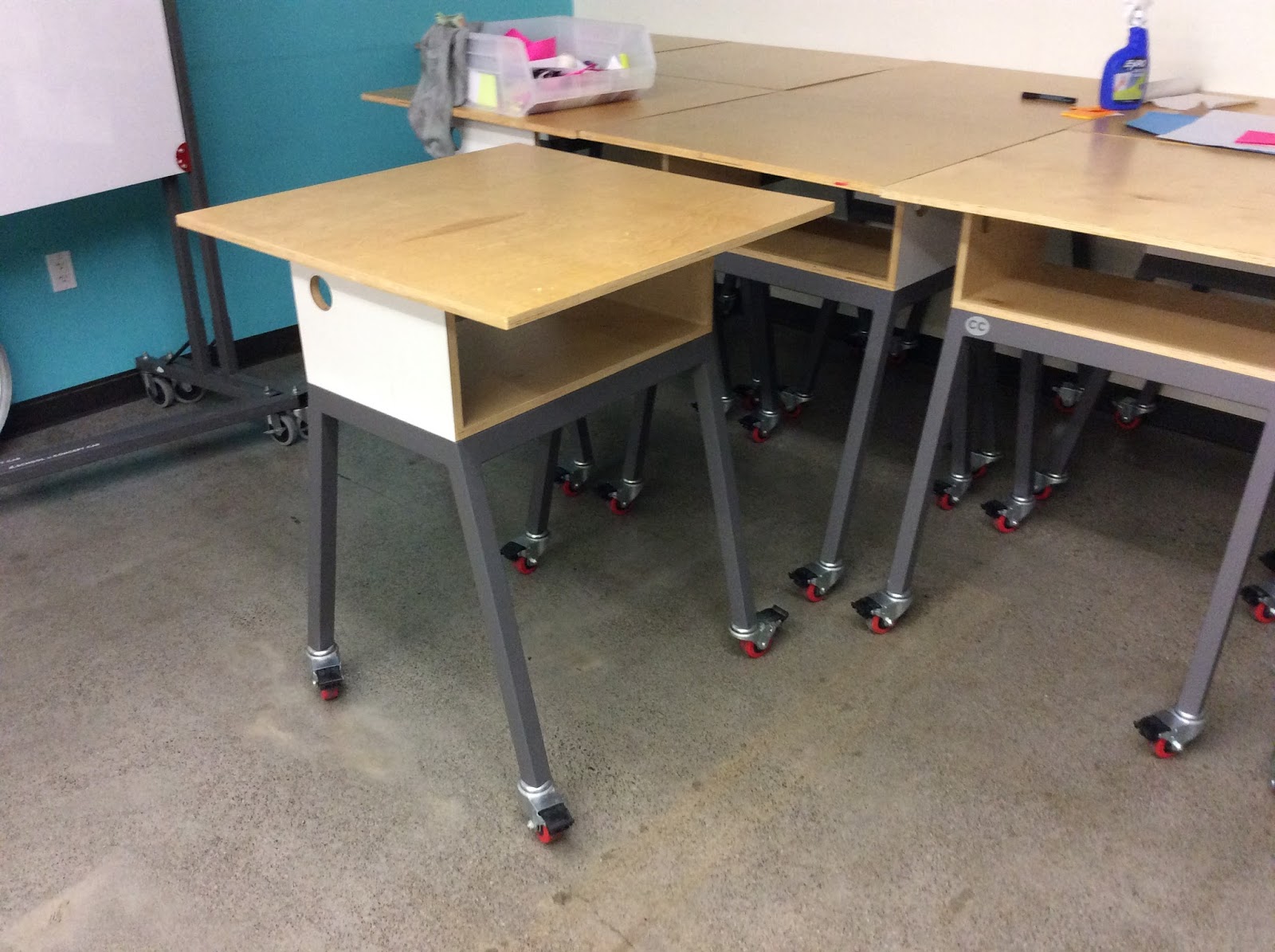
On Friday, I started the day at a new public charter school, d.tech, which aims to be the high school version of Stanford's d.school.  The school started last year with a group of 9th graders and plans to add a new class each year until they reach capacity.  They are also building a gorgeous new facility on Oracle's campus that the company helped fund.  In the meantime, they are acting like designers and creatively making the most of a neat, mostly open space they have now with make-shift classrooms separated by whiteboards, and building on the theme of the d.school, making sure everything had wheels.


It was fun to see how the teaching staff started every morning -- coming together for a standing meeting (scrum), putting all hands in, and yelling a new cheer to kick-off the day.  From there, teachers went to their spaces where they were joined by the students.  Fridays have an unusual schedule because every Friday afternoon is set aside for staff development and the morning is focused on design-lab time.  Students take short (about 6 weeks long) courses of their choice ranging from "building social seating" (groups were each making wooden benches of various designs) to techniques to understand empathy (a classroom-based course where students discussed empathy, watched videos, and did small activities).  Since all students are working on design labs at the same time, all staff (including the curriculum director) teach a lab.  Many teachers do it with a co-teacher.  (Below: a 3D model of the bench, followed by the workshop where teams were building indoors thanks to the rain that took away their outdoor space.)


Another common theme from these awesome schools that d.tech also echoed was integrated social-emotional instruction.  The entire school watched a documentary on male gender-related stereotypes and challenges last week and watched one on female challenges this week.  Afterwards, they discussed the videos and what they learned in smaller groups.  Some of Dan Pink's books emphasize the importance for designers to be both empathetic (traditionally seen as a woman's role) and willing to start building solutions (traditionally seen as a man's role).  Through the videos and discussion, they hoped to both address the cultural dangers of a macho man or 'perfect'-bodied woman, but also reinforce the positive view of how to be better designers.  (Below: the empathy lab classroom followed by the open center-space where they watched the documentary.)


Before I left, I had a great conversation with Matt, one of the two math teachers, about how he approaches the subject in such a non-traditional school.  It was awesome to see that his thoughts are not too different from mine, and very much in line with many of the group-concensus ideas from the #MTBoS (despite not participating directly on Twitter).  His initial curriculum is a hybrid of video lectures (based on concept development, not example problems) and digital practice problems through MathXL.  He sees the same issues that I do from these tools (students not always engaging in videos and digital curriculum presenting a chopped-up view of mathematics), but also takes the designer perspective that it is much better than a traditional, one-pace lecture course and he continues to ask big questions and redesign with his team as he goes.

We also talked through my Grand Challenge Design course for next year.  Given all that I wanted to embed in the course (more than 4 years of college), he highly recommended that I scope it DOWN.  One thing he liked from their design labs was modularity and choice -- there were labs on real-world building (like the benches), design mindsets (like the empathy class), and there was an incubator program for students who wanted to take an idea to market (something an Olin friend was volunteering with that day).  He recommended that, if at all possible, I didn't work alone, opting instead to team teach.  Given cost constraints, I may need to get creative here (community volunteers, recent graduates who want to TA, or student teachers all come to mind).

Matt also acknoledged the challenges I would face in teaching design, the largest being student apathy during open-ended activities and a fear of opening up while interviewing or doing empathy-building activities.  From what I know of students' reaction to similar things I have done in the past, it will be a big hurdle.  To help, he suggested lots of improv games as daily class starters to get students more comfortable being silly and taking social risks.  He also recommended lots of hands-on quick-build activities (such as the popsicle stick house that has to survive a "windstorm") to get students to practice the "bias towards action" that designers always talk about.

Creativity and Design (Part 2 -- the d.school)

Later Thursday afternoon, I broke from high schools and visited Stanford's Design School, known as the d.school.  I joined another Oliner, Andrea, who was the TA for an undergraduate 101 course that served as an introduction to design (a course that recently was approved to meet Stanford's creative expression requirement).  The last day of class turned out to be a great time to jump in -- I saw final presentations, students' finished design notebooks, the professor's summarizing lecture that pulled everything together and reviewed what they learned over the quarter, and I ate some of their coffee and donuts.

The student presentations followed a simple format: introduce a persona character, state their problem, walk the audience through your idea generation / sketches, present your solution (slides and a physical prototype), and explain how the solution solves the character's problem.  Most students did a great job keeping slides clean and highly visual.  Many also used humor throughout their presentation to engage the audience.  The prototypes were not particularly high quality, but that was not the intent -- they needed to work through multiple iterations of the design to make sure that they were really solving the user's problem.  For this particular project, students worked alone and they were their own user, so this step was much simpler.


The summary at the end focused on the key attributes of the course.  His goal was to increase students' fluidity and flexibility with idea generation using open-ended sketches and structured activities.  He gave a few assignments specifically to improve students' ability to make realistic sketches.  He talked through five key habits of designers: use radical collaboration (teams of people from very different backgrounds), reframe problems in new ways, use curiosity and wonder, be mindful of the design process, and always have a bias toward action (when in doubt, start making something).  He also pointed students to resources they could (and I could) continue to use: the collaboration toolkit and the rules of brainstorming.  Finally, he ended with a "pinning ceremony", where all students had to find someone near them and award them with a small black pin to signify that they are now designers.  It was a neat way to end a course.  Even I got pinned!

After class, Andrea took me on a tour through the spaces.  For being so well known worldwide, it is actually pretty small -- about a building and a half of space.  Everything, literally everything, was on wheels (nice ones too).  They deeply believe in the importance of physical space and its layout, and thus the ability to quickly reconfigure the room as needs change.  They don't have white walls, opting for color all over.  Whiteboards are everywhere -- some hang on a hook so you can leave your sketches up over time (just move your board to the back of the hook), while others are large and roll on coat rack bases.  There are small, quiet team spaces and large open areas (with the ability to sub-divide them into more intimate ones).  Graduate students had a little cubby area where they could store projects in progress with open lab tables in the middle of the room to use while actively working.


I plan to borrow lots of these ideas as we build out our robotics lab / Grand Challenge Design classroom this summer.  Most of the concepts are low-cost, but yield a number of great ways to setup a working and learning environment.  I also have to embrace the idea that design is messy, all while figuring out strategies to keep our space clean enough to use for multiple purposes throughout the day.

Creativity and Design (Part 1 -- Del Mar High)

The final days of my adventure were spent in the San Francisco Bay Area.  This part of the trip involved a heavy dose of Oliners and design-centric education.  Though unusual by traditional standards, it was what I was used to from my own undergrad years.  The application to K-12 was really amazing to see first-hand.

My first stop Thursday was Del Mar High, home of the Dons (interesting mascot) and my Olin friend, Becca.  She is at a traditional, high-poverty school teaching physics.  The quotes around the walls scream growth mindset.  After greeting each student at the door, she facilitated an open-ended water wheel design activity.  Teams of 3 needed to use cardboard circles, dixie cups, straws, and skewers to make a wheel.  When the team poured water on the wheel, it was supposed to turn with enough power to lift a cup on a string filled with metal.  The tough part was that most of the students seemed to have no idea how to deal with a open-ended design-build challenge.


It was interesting to watch Becca return student requests for help and direction with questions that prompted them along in carrying out their own design.  As I interacted with some of the groups, I found it interesting how many students felt very comfortable taking the cardboard circles, attaching them to each other, and putting them on a spinning axis, but had no idea how to approach the problem of capturing water in order to make it move.  Like most people, they simply avoided the hard part, hoping a teammate would figure it out.

The morning reminds me of the challenges of open-ended learning when students have been trained for years on recipe/fact/algorithm-based direct instruction.  As we move towards more of these experiences for students, this becomes less of a challenge, but until then we need to invest a lot of effort into teaching strategies to students that help them create their own structure in open activities.  Sets of questions (sometimes called lenses), such as "what is the most important mechanism in this product that will make it work" or "what is the hardest component to design", are the kinds of questions I ask myself before jumping into a new construction activity that give me focus and direction amongst the ambiguity.  Keeping this in mind as I plan for next year will be huge if I want to be fully hands-off by the end of the year.

It was also awesome to see her school's old, abandoned wood shop.  There are a number of amazing machines (a laser cutter, multiple lathes, don't get me started) and a huge open space, but since the district made cuts in their career tech programs four years ago, it became a junkyard.  Becca was recruited to the team of teachers who are planning to transform the space into a modern makerspace.  She will be teaching the IB Design Technology course next year in the newly renovated space.  Becca's planning will be much more constrained by the IB requirements than my own planning (purely open elective), but I hope to use some of the principles of this course to add structure to my own and create enough points of overlap in the curriculum that we can work together and help each other design amazing experiences for students in both schools.