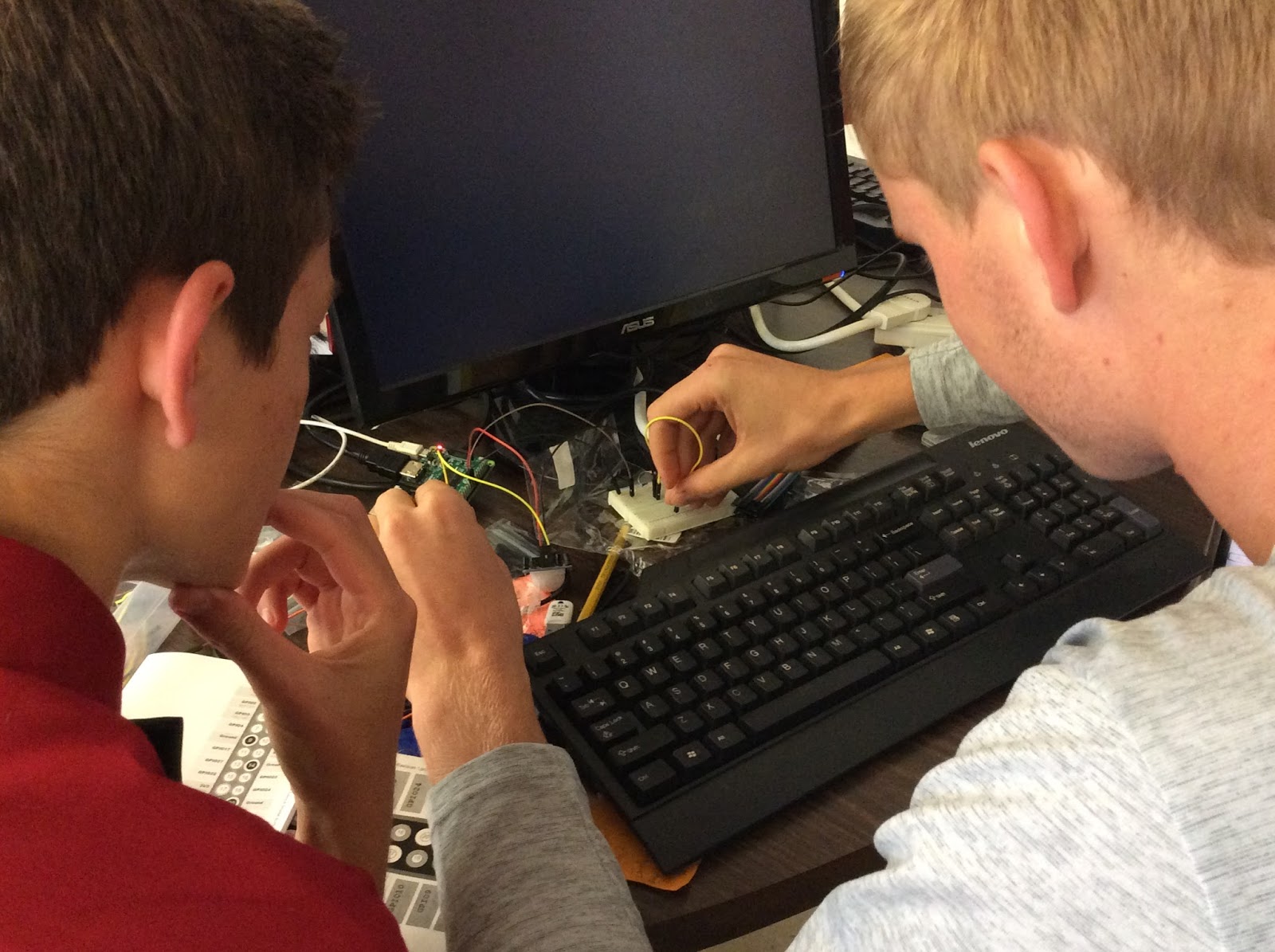
There are tons of things I'm excited about this school year, but a craft of pain and love has been the development of a pretty cool intro unit to our co-taught Algebra class. The goal is to build a base for an understanding of functions that we will explore in depth all year. We start with linear because they are used to it (I'm pretty sure that the goal of 8th grade is to pound lines into brains), but everything in this unit is a launching point for something else.
I like the daily variety -- students graph conceptually (with Desmos sliders), read stories, write stories, create equations, make tables and examples, create patterns, interpret patterns, and have to constantly use words to explain what is going on. It is inspired by a ton of cool resources that we've stumbled on in the Math Twitter-Blog-osphere, especially Visual Patterns. It builds up throughout the unit until the last two sections put the pieces all together as prep for a two-giant-question test. Each section has short quizzes with retakes to demonstrate complete mastery.
Besides being a base for normal mathy things like quadratic functions, it also introduces elements of the Bootstrap Algebra curriculum. Bootstrap is a free programming environment + curriculum designed specifically for teaching math. It is exciting because it involves students making their own video games, but it also offers an efficient way to teach a deep intuition around what functions do and how they work. It uses a custom-design programming language and environment based on Scheme, a "functional language". This is different than most languages used in school and industry (C, Java, Python) because it prevents anti-math statements common in software development like x = x + 1 from creating math misconceptions (amongst a bunch of other benefits). The main developer, an amazing guy named Emmanual, has a deep understanding of both software and effective math instruction. If you think you like Bootstrap, I recommend the in-person workshops to really build up a sense of purpose and a vision for implementation.
The unit is broken into seven sections that bridge different forms of linear functions:
A: Tables to Graphs (graph points in Desmos, match a y=mx+b line to the points with sliders)
B: Visual Patterns to Words (analyze a pattern for rate of change, starting point, and create stories)
C: Words to Tables & Examples (read a story, work through Bootstrap example cases, fill a table)
D: Words to Visual Patterns (create a structured pattern from a story)
E: Words to Equations (work through a simplified Bootstrap design recipe and create an equation)
F: Visual Patterns to Tables, Words, & Equations (review pattern -> everything else)
G: Words to Visual Patterns, Examples, Tables, & Equations (review story -> everything else)
Feel free to borrow/adapt any of it if you wish. Email me (rockychat3 at gmail) if you want a set of A/B/C quizzes and a test to go with it. And please, comment or email me if you make it better -- no hogging good ideas. The example stories are definitely a weak spot.
Note that graphing is only briefly introduced at the start and then goes largely ignored. In our 3rd unit of the year, we explore the different forms of writing equations and spend a ton of time creating graphs in the most intuitive manner from each form (of point-slope, 2 points, slope-intercept, parallel/perpendicular to something).
Also note that sections are named after dinosaurs, because, why not? And only one of them is made up due to the fact that real dinosaurs that start with F are not things you want 9th graders to try to pronounce.
I tend to plan out blog posts and iterate a few times before posting, but this revelation hit me like a ton of bricks 10 seconds ago: I am oddly motivated for next school year. I just submitted my 2016-17 grades yesterday. I have always loved what I do, but not like that.
The speed of the turnaround is connected to a lack of burnout. This was an exhausting school year in many ways, but it didn't kill me like most do. I think a few things helped with this.
First, I had a baby in January. Usually, this should have the opposite effect, but it meant paternity days. This is the best concept employers ever came up with, as it gave me an opportunity to continue to push hard at work while making myself available as actual help around the house. It was also a chance to really enjoy and treasure the early days with my son, Lukas, who is now a giant 4-month-old. Without this time, that would have been just a blink. A day out of the classroom is hard, but when you have a fantastic sub (thank you, Marlene, and other Byron teachers subbing during prep), you can trust that most things are still carrying forward. Since my 9th-grade class is co-taught, it also meant continuity while I was out. This fell on the shoulders of Rachel, student teacher, and Brandon, SpEd co-teacher, who were great. In all classes, the team picked up my slack. Thank you.
I was gone even more with an extra trip for robotics. This was our first year going to Worlds down in St. Louis. The extra 3-days out of school following 2 schools in Duluth for our regional created more breaks from the usual daily routine.
I also had a relaxed schedule this year. The teacher schedule typically consists of short lunches, sprints to the bathroom between classes, and generally running around with your head cut off. Instead, I had prep in the morning with my co-teaching team immediately followed by math. After that, I left the building to meet a tiny section of Grand Challenge Design students. This time was heavily self-directed by students, freeing me part of the period to further develop the classroom makerspace, handle space logistics, and do my own tech project to further skills that I would need to later teach students. Being in another building the rest of the day also meant not taking on a high school advisory, saving independent time to continue these projects. My day ended with my larger GCD class which, though crazy, had a positive energy with great ideas and questions. Rather than running to my next class, students trickled in as they arrived from their drive and I had a chance to greet them at the door. Unfortunately, I'm back to a more traditional schedule next year, but things are in a much better place to not depend on that R&D/setup time next year.
As part of the extra time, I took on a lot more roles. I was a construction worker, electrician, purchasing agent (I raised and spent over $8,000 with an average purchase around $20...I was receiving a package/day or more for the entire year), accountant, connector, custodian, designer, engineer, architect, and probably a zillion other things. The variety was exhausting at times, but it was truly invigorating. I learned so much and dabbled in so many things while trying to bring our space and class to life.
The year also ended looking forward. I had a ton of opportunities to reflect with awesome people.
The Bush Foundation hosted "School Design for Personalized Learning", a series of sessions designed to help school teams implement personalized learning and apply for Bush funding to support the work. Our team of co-teacher Brandon, principal Steve, tech/innovation director Jen, and instructional coach Andy, did the first session virtually at our own pace. We then traveled to St. Paul for the follow-up, focusing our design and ideation around our challenging 9th-grade inclusion Algebra class. I will create a full post on our ideas for that class, but we discovered that the core problem was class culture and our ability to create an emotionally safe space for learning. Besides major changes in classroom management, we plan to positively frame this with a weekly trip to the elementary school to have our struggling learners tutor younger struggling learners. We will focus on mindset, language, and approach with both our 9th graders and tutees. An additional idea to build in computer science and game design, fueled by an opportunity from the Infosys Foundation, DonorsChoose.org, and Bootstrap, have us especially excited for the next iteration of our Algebra class.
GCD also went through significant reflection, but that was fueled by conversations with my students. We spent hours thinking aloud through the early game-construction / R&D part of the course, the game phase, the game redesign, and the open project time. We reflected on what was fun, what was productive, what was hard but positive, what was frustrating, and what the next generation of the class could look like. The vision I have moving forward emerged directly from all of these varied conversations. It will still have significant revision throughout the next school year, but I now know SO much more about where to go that the initial plan should be able to hold.
I also had a chance to reflect with my college friends on the year. Thanks to a weekend ordination of an engineer-turned-priest (some of us Oliners stay engineers...I swear), a number of my favorite people were in the same place at once. As I talked about the year, they provided a lot of great feedback and ideas on what I could try next. Many of these friends were GCD mentors for students and thus stayed in the loop, in some form, during the year.
Finally, the Robotics team is fired up and moving forward, and their energy is carrying me. Our new coach, Sean, designed an amazing structure for leadership moving forward. Each student leader is paired with a 1:1 or 2:1 mentor for an initial interview, monthly reflective check-ins, and ongoing support. The student leaders then, as a team, divide up the roles and collectively run the team. The model's design makes students far more likely to make decisions, with adult support, rather than the opposite. By starting now, it means that we will have strong recruiting, clear organization, internal training, and a healthy rhythm heading into the year. Coming off of St. Louis and the state tournament, the team is hungry to be back. This energy means that I am actively spending time in reflective and forward-looking interviews with students, churning my gears about what comes next for our team, our space, and GCD.
I will admit that I slept 9 hours last night. That felt great and my body desperately needed it. I also spent the full day with my kids while my wife worked the last of her 12-hour shifts for the week and had a great time with them. That said, I am back in full planning mode for 2017-18. I will grow a ton as a teacher and classes will be so much better for students than they were this year.
After two years, it is hard to believe that my graduate program is coming to an end. At this time in 2015, I had no intention of taking additional grad school courses anytime in the next decade. Jen pitched her new program as a small cohort that would explore digital instruction, reflection, connection to other educators, student passions, teacher passions, design, and teacher leadership. Given the people involved and the district's offer to cover the costs for participants, I didn't dare miss out.
Looking back, we got what we were promised. The five courses were each intense and pushed me to be better at a lot of things that I considered myself above average with. The final course, which focused on leadership and design, introduced fewer new ideas and instead tied things together.
I found the single most impactful element of the course to be our study on influence. We read the book Influencer, a book with a great framework that focuses on vital behaviors and crucial moments. It also identified six sources of motivation to encourage change. I had read the book before, but the more structured study led me to understand it much better. Additionally, we demonstrated our understanding of influence and the diffusion of innovation with a simulation. This website puts you in the role of a staff member who is attempting to spread a new teaching method across the staff. I love simulations, but this one was very well done and felt accurate to the research. I believe that more specific and applied influence strategies will be the most powerful skill I can take away from this course.
We further explored leadership in the course in a few ways. The book "The Truth About Leadership" went through 10 concepts that proved true over a number of years. I reflected on many of these in a number of blog posts. This process forced me to dig deeper into my practice, realize how I already was improving, and look at all the space ahead of me to continue getting better.
The course also looked at innovation via design thinking. Innovation is change, an important attribute for both formal and informal leaders. Design Thinking is a specific process that starts and ends with end users. It allows leaders to learn about their customers and provides a framework to help designers maximize design iterations. Our final cohort activity and project used design thinking to learn about and design alternatives to professional development.
The program as a whole did a great job of taking my strengths and pushing them further. Jen's use of reflection and self-driven project work allowed all of us to move beyond the basics and find the appropriate level of challenge.
It was also helpful to look back on my goals from two years ago. I believe that they are still relevant, a positive thing that shows focus over an extended time. My first goal was to improve traditional math instruction. I don't think I am anywhere near where I want to be, but two years of teaching an intervention Algebra course has underscored the importance of relevant curriculum and multiple pathways that each demonstrate content mastery. This course also led to more outreach to the MTBoS community (an open blog and Twitter-based group of math teachers) where I find great resources and amazing people to help me think through ideas.
My second goal: Improve non-traditional STEM experiences in Byron. This took form as Grand Challenge Design, my year-long class focused on major world challenges and the internet of things (IoT) technologies. This course wasn't even an idea when the program started. Now, it has gone through many iterations with my first group of students. There were many successes and twice as many failures. With the help of my students, I am learning the technology, understanding what students care about, and figuring out how I can inspire students to do awesome things. I explored grading and assessment, use of time, teams and individual work, and many other areas. Everything about this course was highly influenced by the Innovative Instructional Leadership graduate work. Beyond GCD, this goal also looked at robotics at all levels in Byron. I helped to grant-fund and kickstart the FLL Jr. and FTC programs so that students of every age in Byron could engage in the fantastic FIRST robotics programs. I also continue to actively volunteer with our FRC (FIRST Robotics Competition) high school team.
My third goal was to become an effective leader in an innovative environment. This is harder to measure. My role as a teacher in GCD and mentor in robotics both involve significant leadership in a rapidly changing environment, and in both roles, I continue to improve. I also received a full week in Spring 2016 to expand my skills as a teacher and school leader by observing teachers in some of the most innovative schools across Southern California. I visited High Tech High, Dos Pueblos Engineering Academy, and a number of amazing schools in the Bay area, posting summaries and reflections to my blog. I learned so much during that short trip, and I continue to come to new insights from those observations. I plan to continue to look outward and learn through observation of others around me. I don't think I want to go into administration, but I do want to be in a role where I have significant responsibility and can lead peers while remaining in the classroom.
Looking forward, I am excited for what comes next. The program ends, but I will continue to try new things, reflect, and connect with peers to accelerate my learning.
My greatest strengths as a leader line up nicely with the last three chapters of Kouzes and Posner's "The Truth About Leadership": leading by example, being a continuous learner, and always having heart. My greatest weakness, communicating the path forward, is what sits between heart and example. I think the only solution for this is to not only be a lifelong learner, but to teach those I lead to also become better learners.
Grand Challenge Design is a great example of my problem. I lead the class with lots of heart. Deep down, I believe that the fully implemented version of this course will enable young people to develop new passions and useful skills, see school as serving both an immediate and a long-term purpose, and help our world actually solve huge challenges. More immediately, I care deeply about the students I have today and have many 1:1 chats and small group conversations in order to better connect with them as people and help them grow.
As a vision-leader for the course, I can picture the kinds of thoughts and conversations that students are having in the fully-built simulation. I can see them exploring a variety of business strategies, analyzing the tradeoffs between health and economics, deciding how best to organize a city, and trying to troubleshoot network problems on a handful of devices. The problems they deal with are far above their head, giving them a great reason to connect with adult mentors who can support them in their learning. In my head, all of this connects to a handful of experiences in my past in fuzzy ways that makes it hard to fully nail down exactly what the end goal looks like. All I know is that it will "feel" right when we're close. It is hard to get others, especially high school students in a small city in Minnesota, to see the vision in my gut. Even for those who do have a decent sense of the end point, the path forward is fuzzy at best.
For me as one of the simulation designers, I am comfortable with the fuzziness because I know how to take the next step forward. I am very confident in my ability to learning anything -- if there is something I need to understand or be able to do, I will use the internet and the help of the people around me to figure it out. I am also comfortable with iteratively deploying an idea and adapting as I observe and hear feedback. As an individual designer, that works great. The problem is that I am a leader of a large class of co-designers who need direction and support.
In my math classes, I see the vision of the full course with a lot of clarity, break down the whole into units with testable end-points, and further break down every skill into its finest components so that every student can master it. In GCD, I only lead by example. I do a little bit of programming to blaze a path, then handoff the clearer tasks to a team of students who can create new things from my initial examples. Two of our mentors lead in similar ways with our physical game board and our network control system, leaving lots for students to still learn on their own, but making the path forward clear enough to get started through their own examples. The power in this model of learning is that students can learn side-by-side as other adults and I try things we have never done either. The challenge is that we cannot give clear explanations or promise that the thing we're trying now is the best way to do it. It is also a painfully inefficient means of transferring skills. It prepares students for challenging, open-ended work, but it doesn't lead to students exiting the course with a great set of hard skills.
I believe that in an ideal education, there is a time and place for both. The more skills that can be directly transferred, the better, as it enables young people to do interesting, professional-grade work. The R&D and exploration help students learn how to learn and to handle the kinds of challenges that many employers need to solve: the problems that haven't been solved (well) yet by anyone else. In GCD, we are trying to reinvent how classroom learning works, so none of us know the obvious path forward. To actually teach students how to learn, I need to push them to try new things and use the online resources and people in their lives to support them in solving problems without me. I need to show them frameworks for Design Thinking, Future Problem Solving, Entrepreneurial Thought & Action and Lean Startup approaches, the Engineering Process, and other approaches that make fast learning and broad thinking likely to take place. However, I need to make sure that I build the need for these frameworks into the simulation or course so my advice and support come as a solution to a problem rather than an add-on to a busy day. I'm making progress, but I have a long way to go yet.
One thing I'm learning fast is that I'm doing a lot of hard things this year. Going in, I knew that designing a game that teaching advanced tech while simulating the world and exploring Grand Challenges would be tough to facilitate. I also knew that an intervention math class that is aiming to pull kids to accelerated levels of proficiency by the end of the year, while managing a huge variety of personalities and behaviors, was going to be draining and tricky. There have been tons of bright spots in the year, but not right now.
In our Grad School prompts this week, Jen asked us to reflect on our support team and the role of trust in change. Both fit together nicely with how I get through each day.
When I started teaching in Byron, I was a year-long intern working under math teachers Rob and Troy. They were core support throughout that first year and the many years to follow. They had a ton of useful experience to draw on, but usually, they just asked me the right questions and facilitated my own learning. For this, I could never repay them.
More recently, I spent a larger fraction of my day teaching intervention math classes. With Independent Math (self-paced, computer-based curriculum), many of my students were also in a Study Skills course. I was constantly connecting with those teachers for strategies and support. I also had a lot more behavior and emotional problems, so I spent a lot of time connecting with the office team. When I started co-teaching last year for the Basic+Intermediate Algebra course, collaboration went from a nice support to daily life. Ashlee (SpEd) and I constantly helped each other think through the challenges we faced in the classroom. Because things were so difficult for both of us, we constantly reached out to our instructional coach, Andy, our principal and asst. principal Steve and Malia, and a number of peers across the building that we looked up to. Our support team formed because of our problem and all the people who cared about us and our students. Now, as I teach a class with different (and I think harder) challenges with Brandon and Rachel, I again can't imagine doing it alone. Their teaching skill supporting me each day is huge, but the emotional support of doing something challenging with others you trust is very powerful.
I also have a somewhat separate network that I turn to in pushing forward with radically new innovations in the classroom. I was fortunate to be granted time to work with Matt Weyers and the awesome teams he was with during two years of PBL pilots. Matt continues to push me and help me think through my own course designs. Around the same time, I was a Digital Learning Coach under our tech director++, Jen Hegna, who is a force of nature with innovation and pushing deeper learning forward in the district. She has individually encouraged me, provided crazy amounts of feedback, and helps spark a number of ideas. My graduate program and all that it pushed me to think through is her fault. Support has also come through our admin team -- they feel like bulldozer drivers sometimes the way they just plow through barriers. I can't think of a district where an idea can be pitched and a 2 credit class can be on the books in under a month, and then by the next fall, a 3-teacher interdisciplinary course based on it is already taking its place.
A third network, the robotics program, has been amazing. When I started, there were a couple crazy adults that joined late in the year to help. Now, there is an army of parents, alumni, and community members that make our team and everything we do just hum along. The team is so powerful that I was able to step down as head coach this year, be replaced by someone without specific experience in FRC or robotics, and our team is doing better this year so far than we ever have. I love working with and learning from this group of fantastic mentors. I also really love working with the group of kids that have been part of the program for many years -- I have deep trust for them, and over time, have earned their trust. Despite all of the adult support for Grand Challenge Design, I told my robotics students to take the class (a HUGE schedule killer) and 13 of 17 did it without seeing any plan. If that isn't trust, I don't know what is, and I am more motivated than ever to follow through with that in GCD this year.
Outside of school, I am incredibly thankful for my wife who loves me even when I'm not that lovable. As a bonus, she pushes me, gives me ideas, and creates time and space for my own passions. The emotional support network of my friends in Rochester and my family back in Wisconsin enable me to take all the risks that I do. The wider network of friends from college that helps me think through my ideas and reflect on tough questions is also amazing.
My support teams across the board are built completely on relationships. At school, change happens quickly because of mutual trust -- I know what is expected of me when trying something new, and everyone involved knows that I will do what it takes to will something into existence. I spend a lot of time talking to people in any given day, mainly because I need to in order to do my job well. In most cases, I have lived up to others' expectations and built a track record of working hard and caring for kids. I am also usually good about building a track record of caring about my peers and helping when I can. This creates trust.
Do I think trust is necessary for change? No. Is it necessary for fast change? Absolutely. Rational people will eventually change when they believe that the new way of doing something is better than the old way, assuming they have the time and support to learn the new way. You don't need trust to come to that belief, but that means you have to experience it yourself. In a high-trust environment, I will try something just because you say it is awesome. You will give me permission to take risks without proof that I know what I'm doing. This lets innovation and new ideas take-off in an organization. In a culture that is focused on student learning and growth, not just new-ness, all of this innovation will be constantly evaluated and tweaked as groups of peers push each other to improve. Trust is the catalyst that gets everything moving.
As I push through the challenging spots of this year, especially with a new baby about to be born any day, I am SO thankful for the people in my day-to-day and the extended team around me, those listed above and the countless others who are pouring into me daily. I don't have all the answers, but because of all of the people I trust that surround me, I don't need all of the answers. I just need to be open and honest with my challenges and be willing to listen as they help me do what is best for our students.
As part of an entry to the US Department of Education's EdSimChallenge contest, a few students and I wrote a 2000+ essay describing our vision. Since the course title Grand Challenge Design no longer communicated the meaning of the simulation itself, I rebranded GCD as the MiniCity Simulation. I thought it was worth sharing our contest video and application.
Submission Description:
A classroom of student business owners cooperate and compete in connected industries to keep a 3D-printed miniature city full of digital citizens healthy and happy.
ENGAGEMENT: Describe your simulation concept, including an overview of the content and a brief walk-through of the planned user experience. Identify which types of learners your simulation will initially target. Describe how your simulation will engage users at a level on par with commercially available entertainment games.
MiniCity plays like a multiplayer game of SimCity on a physical game table built up by the class.
Students control physical land, digital money, and a Raspberry Pi computer and use these to build up a business empire. Students have a choice in where they make their investments: game industries include food production, transportation, energy, and housing. Each of these includes key components such as farms, grain mills, and grocery stores. Since all parts are interdependent, players need to monitor the decisions of their peers to decide where they can add the most value. As they engage in their role, students become emotionally invested in the outcomes of their companies.
Despite the individual autonomy over land and businesses, MiniCity is a cooperative game: the class collectively wins by maintaining an 80% happy population of virtual citizens (determined by income, housing, environment, and other factors). All players are punished by unhappy citizens through vacant properties and understaffed businesses.
Players also control governments at the county and town levels. They have the freedom to experiment with the system of government of their choice. They can also pass laws that levy taxes, ban industrial pollution, or regulate housing prices, with every action directly impacting gameplay. The social dynamics in our simplified prototype have already proven how engaged an entire class becomes when individual agendas and strategies collide with a class-controlled government.
The most important game mechanic that engages students is where the technical learning occurs: building new businesses. While basic farming simply requires the purchase of seeds and water, optimal farming requires a digitally-controlled irrigation system and grow lights. To implement this, a student has to program a Raspberry Pi computer to trigger lights to turn on and a pump to move actual water from the central river. In the housing industry, players build upgraded apartments by modeling it in CAD software and 3D-printing it. The teacher’s role is to support students as they physically build their empire.
The bare structure of the game empowers players to fill the gaps with their imaginations. Students stumble upon issues as they progress throughout the game rather than being presented a topic for the day by a teacher. In our alpha prototype, students have already formed intercity corporations, farming businesses, law firms, and banks. Others decided to work independently, becoming career politicians, freelance farmers, and electricians. In an infamous hostile takeover of the county government, engagement went through the roof as the class collectively shut down a student exploiting loopholes and redesigned the entire government to prevent future dictators. Most significantly, students come to class with better and deeper questions every day as we progress through the game: “How do stocks work?” “What is ROI?” “Why are 18 volts running through my pump on a 5-volt circuit?” “How does the government control land use?” “Who pays for roads?”
Most simulations teach the HOW of key skills. MiniCity, despite being much simpler to implement, engages students by making them ask WHY.
LEARNING OUTCOMES: Explain the desired change or transformation in the user’s knowledge and skills. What academic, technical, and employability skill-learning objectives will your simulation seek to transfer? Detail the subject area(s) and/or curricular area(s) that your simulation addresses. Briefly review how your simulation will communicate feedback to the user and instructor with respect to progress toward achievement of the learning outcomes.
Students develop skills in technology, social sciences, communication, and collaboration during gameplay. For a student to progress, they need to develop some sort of enterprise or employable skill. Students will learn to direct their own learning as needed by the game, resulting in one mastering software, another learning to build group consensus, and yet another becoming an expert on water pollution. In all paths, students need to understand the complex system of the interconnected industries and how one action affects other parts.
Along with business, students must learn about government to bring order and consistency to the game. The game begins with a bare-bones constitution, leaving students in charge of government structure, enforcement and interpretation of laws, and passing new regulations. Once laws are put in place, students read them closely to find loopholes, thus providing the authors with valuable feedback on legal writing.
On the game table, most buildings get upgraded by designing a CAD model and producing it with a 3D printer. Every in-game building has basic specifications that players need to meet in their model, thus demonstrating an understanding of this skill while completing a game task. To encourage every player to try a game action like this (rather than relying on specialists), discounts can be offered for the first building. If a teacher has specific content outcomes, she can create in-game objectives with financial bonuses. Students include pictures, screenshots, and short reflections to retain a record of their learning. All of this can be viewed in aggregate by the teacher, better enabling her to notice and intervene with students who are not progressing.
Most game systems require an electrical control system with lights, servos, and sensors connected to a Raspberry Pi computer. The systems communicate data to and from the game server or individual data-monitoring tools. This is the same technology that forms the heart of the Internet of Things. APIs and technical documentation simply become part of students’ daily experience in-game.
Most of the game server comes with no visual interface by design. Students use a Chrome add-on to post API requests to the game server to list products on the market, transfer money, or take any digital action. The inefficiency for people using the API offers an opportunity for players to start their own mobile app companies, selling subscriptions to use a simple, time-saving interface.
The most significant learning comes from exposure to the key themes of the National Academy of Engineering’s Grand Challenges. These are huge, interdisciplinary problems such as providing clean water, restoring urban infrastructure, and securing cyberspace. The problems are embedded as tradeoffs during gameplay that require both diplomatic and technical solutions.
Again, MiniCity doesn’t teach the HOW of any of these skills, and yet in our prototype game, we found that it produced the motivation to learn all of these. Peers, online resources, and the teacher can all offer direction as students learn these skills -- the game simply gives them an immediate reason to care.
COMMITMENT: Describe your team and characterize its strengths and commitment. How is your team best suited to bring this concept to fruition? Describe how your team plans to develop your simulation over the course of the Challenge.
Unlike most teams, our simulation is teacher, student, and mentor-built. We play and develop the game as a class for 80 minutes daily during the school year. With an active role in the development of the very game they are playing, students develop a sense of ownership and are eager to contribute to the evolution of the course.
As the lead developer and teacher, my background spans engineering, entrepreneurship, and education. I graduated from Olin College of Engineering, a school built 15 years ago with the explicit goal of reinventing engineering education through hands-on, integrated coursework. I majored in computing, but outside of the classroom I was learning about and designing tools for innovative schools. Now, as a licensed teacher, I have been working to innovate school curriculum to engage students more holistically.
Development and continuous feedback are supported by the pilot class of 23 students. Half of our class days are spent designing and building the game with the remaining days focused on playing the prototype.
As a group, we work in fast two-week sprints to iterate the rules and introduce new game components. In November, we had a generic idea and rough set of rules. Now, we have a functional NodeJS game server, a home-brew CNC router operational and cutting out the hexagon-tiled surface of the 6’x13’ game table, our Raspberry Pis are successfully running a mentor-developed control system, and the game economy is relatively balanced.
Over the coming weeks, we are expanding the prototype to include virtual citizens, housing, and employees. Once implemented, we will rebalance the economy and continue adding new industry verticals one-at-a-time. The game board frame and river are ready and the surface will continue to be machined. Our subteams have clearly defined roles on build days. We are highly confident in our design and implementation processes and see the game developing significantly throughout the rest of the year.
After our initial success, our school district committed to the second year of our course, but this time I will be joined by two co-teachers licensed in social studies and language arts. In this integrated course, we will re-theme the game so that players experience the challenges of ancient city life throughout key periods of world history before advancing to the present. The three-teacher team is critical for clarifying and deepening the learning objectives embedded within the MiniCity simulation so that students can earn a variety of required credits in a single course block.
Moving beyond the small town of Byron, MN, I will leverage a broad base of teacher contacts locally and nationally through my blog, Twitter, and the Grand Challenge Scholars Program. I also have engineering contacts through Olin College with deep ties to progressive high schools. This network can be greatly expanded to many interested teachers with the help of the Department of Education and the EdSimChallenge contest.
IMPLEMENTATION STRATEGY: What tools, software, and/or hardware will be required to run your simulation in the classroom environment? Identify any anticipated logistical, technological, or economic barriers to deploying your simulation. Briefly preview your initial thoughts around distribution, implementation, and integration with existing and future technology. How do you plan to control the costs associated with purchase and maintenance of the simulation and associated technology?
MiniCity has a fully open and modular design. The only limitation from bringing it into another classroom is the teacher’s confidence jumping into a host of new technologies. Its dissemination will rely on a core group of innovative risk-takers to adapt and try the simulation at their school. This group can then mentor and encourage the next wave of teachers as they make it work for their students.
In order to ease the transition for new teachers to adopt MiniCity, a top priority over the next semester is compiling and creating tutorial videos that demonstrate the setup of the core technology. This will also help my own students as they try to efficiently share their different knowledge domains with one another.
Thankfully, cost is not one of the major barriers to implementation. By starting with almost no money ourselves, we designed with low-budget schools in mind. Through the physical game table, MiniCity immerses users without expensive VR sets or advanced PCs. We built and operate the digital game server at no cost. All electronics were sourced for incredibly low prices from China. All startup supplies for a class of 30, including 1:1 Raspberry Pi computers, can be purchased for under $3000, well within the range of a grant or many schools’ technology budgets. Adding 3D printers to this adds $400-$900 per unit. Ongoing costs for additional plastic filament and replacement electronics are under $1000/year.
By the end of the school year, the full game rules, technical documentation, parts lists, and software will be organized into a single website. The site will also include any learning resources we create or compile. Our goal is to make everything we do transparent and available for innovative teachers to jump right in. I am directly invested in this process of organizing as I prepare to bring two new teachers on-board at my school before next fall.
Ongoing maintenance will be a task for the open source community around the game. I intend to continually use MiniCity in my classroom for years to come and thus remain a core leader in its maintenance. Beyond free online support, I would run a summer workshop at our school to prepare groups of interested teachers and professors to launch their own MiniCities by the fall. My students or I could be contracted to provide further on-site or 1:1 support.
Once adopted, MiniCity can be significantly adapted to meet a variety of educational outcomes, including the world history theme that we will launch with our own students next fall. Re-theming the simulation is highly feasible for a variety of classroom content areas thanks to the modular application design.
LONG-TERM VISION: How might your simulation fit into a future ecosystem of simulations for career and technical education (CTE)? Briefly describe preliminary thinking around how your simulation could connect with other simulations through approaches to data handling, use of APIs, integration of open source tools, and/or implementation of Experience API (xAPI). Describe your vision for how the simulation could expand or scale. How could your simulation be built upon by other developers?
Within the world of simulations, MiniCity offers a break from VR sets and TV screens to put students face-to-face around a complex challenge. The broad nature of the experience gives students a chance to try out many roles -- business leader, congressperson, farmer, engineer, electrician -- without committing to a narrow track early in high school. My students and I believe that this simulation will be the catalyst that encourages students to go deeper with more focused, single-career simulations in future coursework.
The simulation software will generate key financial, health, and happiness metrics each day as it analyzes the decisions of the virtual citizens. From this data, it could export useful stats to xAPI or similar systems that universally track student actions. The open source tools would allow new teachers to see how an established system works and thus make their first course flow more smoothly.
The simulation will grow in multiple respects. New industries will be added as new microservices in the application. Political structures will evolve. Beyond gameplay, the simulation as a course can expand to formalize the education students receive in language arts and history. Over time, additional coursework including entrepreneurship, statistics, political science, and agriculture can all be integrated.
The most exciting possibility for MiniCity is the chance to directly connect with additional sites around the nation and world. Rather than simply selling goods at the ports “overseas”, students would now be able to actually sell their goods through a peer-to-peer market to another classroom. Prices for virtual materials and services would be shared via API requests between MiniCity simulations. A new layer of government, the state, could be composed of student representatives from dozens of classrooms who are working to pass fair laws across the entire system. This opens a whole new world for trade, business, entrepreneurship, and politics. The learning experience gains value as you incorporate more and more students, and even community mentors, outside of a single classroom.
These classrooms could also connect outside of the game to present their learning at conferences and organize social meetups. In particular, the social network of the teachers would stay tightly connected online as we support each other in the implementation of our shared virtual society. The social integration and buy-in of a worldwide group of teachers may be the most powerful opportunity for MiniCity to advance engaging student learning.
As our Innovative Instructional Leadership cohort continues through Kouzes and Posner's The Truth About Leadership, I was asked to reflect on what brought me into education, what roadblocks are in the way, and what new opportunities lay ahead.
I fell in love with education in my first year of college. Olin College was my top choice school because of its hands-on and student-driven approach to engineering from the very first day of class. As I was heading into my second semester, I was part of a group of six students who decided to create our own class, MetaOlin, and find six professors to each teach us a two-week segment. As a group, we studied our own school through the lenses of systems engineering, diversity and privilege, digital communications, pedagogy, history, and information literacy. Many of the units focused on the learning environment of the college analyzed in different ways, but the specific pedagogy unit opened me up to a totally new field of study. I followed this up the next semester with a course at nearby Wellesley College, Improving Schools, that studied a variety of models of standard, private, and public charter schools that significantly improved student results. By the end of this course, I was so addicted that I needed to take a year off of college just to study our nation's schools.
My leave of absence year was spent living with five other classmates doing the same thing. We found the overlap of our interests -- a startup tech business focused on improving collaborative learning in schools -- and pursued this head-on. During that year, my free time was invested in books about learning (lots of John Holt and similarly old classics). My side job was planning curriculum and teaching at a weekend STEM program for high school students.
In my junior year after the leave, I committed myself to a temporary year-long focus on software skills in order to build some technical competence. By my senior year, I decided that I wanted to create and lead a charter school modeled after the awesome school systems I had been studying and visiting over the past few years. In order to get licensed, I needed three years of management or three years of teaching experience. If I wanted to have a clue about what I was doing, I needed the teaching, so I found Winona State University-Rochester near my new post-marriage home and started the fastest, most hands-on licensure program I could find. That brought me to Byron.
Since I started, my WHY has remained focused on redesigning the system to make learning relevant and meaningful to students so that we would be able, as a society, to solve the complex problems in our world and so that students would be excited to engage in this journey of lifelong learning.
This translated into many of the projects I poured myself into since I started teaching (see my last post). All of this is preparing me to design the best learning environments possible. Moving forward, I am finally coming head to head with the largest challenge that I feared when I started: the credit hour, also known as the Carnegie Unit. Almost nobody believes that learning occurs just because time passes in a scheduled space, and yet the complexities of organizing people into places with enough adults per student has made this piece of our system indispensable. If you add to that the need for whole groups to move through material together in time, the schedule becomes nearly impossible to take on.
I think the long-term vision for this breaks away from a schedule and tracks objective-connected learning for each student. Students still need individual attention and monitoring, making advisors and special education teachers all the more important. Rather than classes, shorter projects and learning modules could chip away required micro-credits for students over time. This would afford the flexibility for new learning experiences that integrate subjects, work off-site, or allow students more choice in their work. I want to be a part of making this possible in Byron and beyond.
The new English/History-integrated Grand Challenge Design course for next year will be a useful first step forward in exploring integrated teaching and learning in Byron. If we can successfully create deep experiences that engage students in multidisciplinary learning, I think we can keep pushing against the traditional schedule and all of its weaknesses, barriers, and cost overhead. I can imagine all 11th graders trading in traditional coursework for a year-long, themed, integrated experience that is heavily defined by their own dreams and needs.
I was asked to reflect on my professional growth since I started teaching, considering risks I took and the leaders that mentored me in the journey. I see a few key actions that pushed me to where I am now:
building and refining project-based (PBL) Stats
coaching our FIRST robotics team
connecting to the MTBoS (online community of math teachers with an annual F2F conference)
co-teaching and co-designing an effective remediation Algebra course
pushing for Grand Challenge Design and its co-taught second round
All of these actions became growth opportunities because of the combination of challenge and incredible mentorship that came from the people around me in each.
As an intern teacher back in 2011-12, my formal mentors (and now co-workers), Rob and Troy, gave me an incredible degree of freedom to try new things. They modeled a process of trying something and carefully analyzing the data to assess its effectiveness. Their lack of experience with project-based learning didn't keep them from letting me try to implement it, but they stayed engaged with me as coaches by asking tough questions and pushing me to reflect on what was working. After developing a first iteration of a PBL Stats class as an intern, Rob handed off the course that he had been teaching for years to let me continue to iterate the curriculum once I was hired on. A few years later, when my schedule crowded out Stats, both he and Troy continued to develop and refine from what I built, despite it being outside of their comfort zones.
During my first "real" year teaching, a student pushed me to start a FIRST Robotics Competition (FRC) team. Thanks to good timing with funding becoming available, we started our team a year early -- two days after the new season's kickoff. This nearly killed me, as it requires spending every second of January-March focused on learning a game, buying up parts, keeping a bunch of kids and families organized and engaged, and...building a robot. We didn't fare so well in our first two seasons, but our team learned a ton and built up a base of students, mentors, and sponsors. Four years after starting the team, we now have two of our own rooms in the Community Education (now district admin) building with 3D printers, a CNC router, tons of tools, and a warehouse of electronics and mechanical parts. We expanded the program down to kindergarten and helped to grow the district to having ~7% of enrolled students on a robotics team. The key to all of this was the network of mentors that we built up: they officially mentor the students, but unofficially have been my teachers and supporters. Many are parents with years of industry and life experience who speak their truth, though even our younger mentors continue to teach me tech and amaze me with their commitment.
One of the easiest, but highest-reward actions as a teacher has been plugging into a community of other math teachers. At my school, I have my PLC team that is amazing. Part of our team always attends and presents at the Minnesota Council of Math Teachers (MCTM) conference each spring, plugging me into the larger community. The most powerful connection has been plugging into the national/global community known as the Math-Twitter-BlogoSphere (MTBoS) -- if you tweet at other math teachers, write a blog, and/or comment on other blogs, you are plugging in. The self-organized community developed a ton of resources that I now pull from and has many of the best teacher-leaders I have ever met providing free professional development and direct support for other math teachers. I am not a frequent blogger or tweeter, but when I hit a wall or am in a new development push, I always turn here first. Though I respected the ideas and resources of the community, I really bought in after attending my first Twitter Math Camp 3 years ago. My first one required a 10-hour drive to Oklahoma to spend 4 days in non-stop conversation with some incredibly kind, supportive, and innovative people who happened to also teach math. After going to dinner or having long chats with so many of these teachers, I am that much more interested in what they have to say in their reflections.
Hands-down, my most challenging experience as a teacher is my Algebra class. It is a co-taught special education inclusion class that is designed to move all students up to grade-level math by the end of 9th grade. The behaviors of any 9th grade class were enough to crush me my first year teaching, but this group and some of the uniquely challenging behaviors were insanely hard for me and my co-teacher, another young teacher, to manage. We had frequent chats with our principal, Steve, as well as our math and SpEd PLC, as they all did their best to coach us through a variety of situations. In order to make things work, we tried everything and found a few approaches that worked well, at least for a while, and built up strong relationships with our class. This year, though I am with a different team, I feel MUCH more confident in my ability to co-teach, to keep order in a classroom, and to teach conceptual thinking about math to a group that has had nothing but procedure thrown at them for a long time.
My most exciting professional adventure came with the start of Grand Challenge Design. The course sparked from an email thread about the idea of a STEM-focused school in Byron, and within a couple weeks, was turned into a course proposal that the awesome leaders in our district and school supported. Conveniently, I was just starting Jen Hegna's Innovative Instructional Leadership Certificate program, and I latched the new course plan to the majority of my coursework. This reading, discussion, and general structure pushed me to plan much further ahead than I usually did, so much so that the idea of the class simulation was born out of work. Jen's feedback, as well as the conversations with other cohort members, pushed GCD far beyond what it ever would have been, and I continue to learn from the students, and class mentors that push me and teach me new technology skills every day. The simulation, in turn, opened the door to multi-disciplinary coursework to purposefully take place within the GCD structure. Again, supportive leadership shaped and approved next year's offering, a 3.0 credit block of technology (elective), social studies, and English credit, co-taught by a three-teacher team. That experience, assuming enough students register for it, will bring full circle the full course development, robotics program, and co-teaching that led me to this point. I can't wait to take what I am doing and learning this year and get pushed by two more teachers that are with me daily.
Looking back, my rate of learning has been crazy-fast, and yet it is amazing how much I still do not have figured out. Being a good teacher is incredibly hard, but I love the journey.
The first quarter of Grand Challenge Design flew by. Though it didn't go like I planned, it was a very positive start to this year-long adventure. The key relational, cultural, procedural, and skills groundwork are in place, our game is going to launch tomorrow, and we have a productive space for learning.
To start the year, every student wrote a letter about themselves, their future, and the course. This letter was based on Ben Zander's concept of transforming relationships and giving every student an A. In the letter, each student gave me the insight I needed to start a successful working and mentoring relationship with them. As first drafts, nearly every letter came in looking awful. To address this, I started with comments and suggestions over Google Docs. For some students, this was all that was needed to lead to a more productive draft. For others, I found myself having one or two 1:1 meetings at lunch, during advisory time, or after school to verbally probe into some of the questions I wanted them to explore. I also reached out to my English teacher colleagues who were amazing in helping me and my students through the writing process.
Once a letter was accepted as complete, I used it to match the student with the best-fitting mentor I could think of. Every student is paired with their own mentor, a professional engineer or designer chosen from my college and local friends who were willing to jump in. I don't know if my students realize how top-notch these people are yet, but they will in time. One mentor, after receiving his mentee's introductory letter, even wrote back with his own letter, written as if he was in high school but then continuing to the present day. As I see some of the email exchanges that I am CC'd on and poke my head into some of the Skype chats during class, I can't help but get excited for all the things students will learn from NOT me this year. As I get texts and emails from mentors seeking additional advice and counsel on how best to help their student, I am amazed at how much these people care about a group of random kids in Byron, MN.
Our Grand Challenge for the first quarter was not the individual work, but the team effort that was required to build up the course. After getting a sense of what students were interested in doing, I divided the class into teams of 2-4 with different areas of focus. From there, I presented the core of the vision to the class: this quarter, we were going to get our game built and ready to play and improve our classroom to be a fun and effective learning space. I structured this into "OKRs", or "Objectives and Key Results", a goal-setting and measuring format created by employees at Google so that everyone could have autonomy while moving in the same direction, have clarity of what they and others were focusing on, and have a system to measure their own progress. I asked each student team to do the same. Here are a few example OKR docs from the teams in class: CNC team, NodeJS team, Rules team.
At this stage, my role involved checking in with each team each day to offer ideas, direction, feedback, or whatever was needed. I also made sure that the different groups were communicating with each other. At first, this process seemed relatively successful. After a month, I found that teams were splitting two different directions: the teams that had long-term projects did okay managing their day-to-day work productively, but the teams with many small tasks had a hard time figuring out where to go next without heavy support. To address this, I introduced three elements of the scrum framework: a product owner, a Kan Ban board, and a daily stand-up
Scrum is used heavily in the software world as a way to help teams self-organize and complete tasks around user needs. The role of a product owner is to decide which tasks need to get done, and what "done" looks like, to achieve the objectives of the company. As the lead person pulling everything together, I was a product owner. However, I also invited one student from each team to take on that role and work with me to generate and refine their team's task list. From here, each team put the tasks on a large kanban board divided into four sections: backlog, in-progress, ready-to-check, and done. The backlog includes all of the tasks that need to be done but had not been started. In-progress is what you would expect. Ready-to-check includes all tasks that the doer thinks is done but needs a product owner to review to make sure it truly meets the definition of done. "Done" is truly done.
We used the board as part of the daily stand-up meeting. Within the first five minutes of class, the entire class crowded around the board and said (1) what they accomplished yesterday, (2) what they were planning to do today, and (3) if anything was blocking them. (1) was for public accountability -- I only realized after we stopped doing these daily meetings how well that was actually working (a few students slipped into multiple unproductive days without this). (2) was for me -- if they said they were doing something, but it didn't sound very useful or sound like they knew what they were talking about, I would either correct on the spot or follow-up with that person after the meeting. (3) was for everyone else to listen to -- if two teams were going to be doing something in the same space or with the same resource, they would have a heads up and be able to work it out ahead of time. This didn't come up a lot during the time where I used the daily stand-up with the entire class, but now that we are closer to fully integrating everything, it seems more likely to happen. I plan to return to using this whole-class meeting daily in Q2 on team days.
Back in August, I pictured the game starting up in a couple weeks after school started. It was only after a couple weeks passed that I realized that my sense of reality was heavily warped. The most obvious challenge we faced was finished the game board surface. Doing so required the use of a machine that we bought in isolated components and assembled ourselves. A former student and older brother of a GCDer led the design, assembly, and software setup for the machine. Unfortunately, the challenges involved in making everything work were more than even this mentor could quickly master. The two students working on the machine, with some weekend help from their mentor, found faulty limit switches, a bad stepper motor, wiring issues, and software configuration problems. Then they went through a time-consuming process of calibrating the machine so that a software inch would be a true inch. To actually cut material, they first needed to design a part in CAD (something they knew well), but then needed to run it through CAM (computer-aided manufacturing) software to tell the machine how to make the part. They needed to figure out which bits to use and how fast to spin them. They needed to find a consistent way to mount the stock wood in the machine so it would remain steady. They needed to find a way to mount a shop vac hose to the machine with a dust-trapper so that the excessive amounts of sawdust would stay contained. And this is not a complete list! Though this team dealt with the most extreme set of challenges for what sounded like a very simple task, nearly all teams found themselves experiencing dozens of complex problems nested within something that sounded straightforward at the beginning.
I love watching students work through this kind of challenge. Given that I am used to students giving up on tasks with lots of direction, resources, and a knowledgeable guide, seeing students persevere with none of these is refreshing. Here are a few action shots from the semester as students persevere through this (thank you, Kris Nelson!):
Finally, I asked students to end the quarter with a video summary that they would share with me and their mentor. This video had to be at least two minutes long and discuss what they did and what they learned. Watching these has been a ton of fun for me since I sometimes forget where students started the quarter. Thank you, Jen Hegna, for recommending that I do this! A few examples are below:
Despite the number of tasks that are not completed yet, I am really excited about launching the game tomorrow and building the airplane at 10,000 feet. We will alternate game days and team days so there is time to continue getting key tasks completed while allowing us to experience what things are actually needed for game play. And hopefully, this time, I will blog more than once per quarter and keep each post under 1500 words.
As part of my Winona State University cohort, we all engaged in a condensed experience in Design Thinking, a process that facilitates user-centered design. Back at Olin, Design Thinking was the heart of the engineering curriculum, pulling together our technical work with entrepreneurship and the humanities in a process that puts people at the core, so this was not a new experience. However, it was the first time I used Stanford-based materials, the first time I did a design project alone, and the first time I went through a formal application of design since I started teaching.
To focus my design work, I decided not to look at all of my students. Instead, the problem I wanted to better understand was why my Grand Challenge Design course was so male-dominated (20 young men, 3 young women), so I studied current 10th and 11th-grade female students, the ones who could register for GC Design starting in January. I did not enter with an expected outcome, but rather let the process reveal insights as they came up. The point was to truly understand and empathize with this group that I was clearly having a hard time appealing to. Starting with this understanding, I could improve the design of the course and more effectively communicate what was already good to these students.
Students are only one of many stakeholders in public education. The federal, state, and local governments all have an important stake, as to community members, parents, administrators, teachers, and support staff. However, given that students are the end customers, it is amazing how little we seek to understand them. An empathy-centered process stops asking what students want (more time to do their existing work, better resources, etc.) and observes what students do, say, and think. From there, I made inferences and connected the commonalities to create a picture of who these students are. One of the more powerful insights I gained from this process is that the students I interviewed were open to creating and the engineering process. Food and art were common places to make and invent. However, content and peer groups mattered. Nearly all of the young women I talked to had clear passions and career interests that developed in middle school, directing their decisions on courses and extra-curricular activities. They were also aware of which courses were likely to be mostly guys, and most of them avoided these. A surprising theme was the belief that they would fall behind in a technical course. This is especially curious because the majority of them said that they did well in their 8th grade STEM course and never fell behind (where is this belief coming from?!).
After this research, I designed my first prototype solution: a two-hour course called "LED Art" on our school's exploratory lesson day (twice per year). I described it as a chance to design your own art project on foam board and bring it to life with custom-programmed LED lights. The description worked! I recruited a class of 13 gals and 12 guys. Though I was working with a lighter supply of materials than I was hoping for, I had enough to run the class. On game day, it was a total disaster. Students managed to mostly have fun and learn a thing or two, but the logistics of helping everyone get a basic circuit running proved just a hair too much for only two hours with my planning. After running the course, I have a few dozen specific changes that I plan to make that will allow everyone to be up and running significantly faster, allowing more time for explorations, programming, and actual art design.
The most fascinating observation of the whole course was what happened when I asked students if they wanted to buy a $10 kit of parts to take home: 8/12 guys signed up, 1/13 of the ladies did. While working, there were only a few people that appeared to know what they were doing, and yet the guys were the ones who seemed either confident enough or interested enough to want to take it home and keep learning. I'm curious is this is an inherent fact about this group, or if there would be different results on taking a kit home if I provided more structured handouts and guides from the start. I wonder if the outcome would have changed if I took the time to learn more names during the session and encouraged each person as they worked.
In the end, the whole experience was incredibly worthwhile. More than any specific insights, of which there were many, I am fully re-convinced that the Design Thinking process needs to guide any important decisions that I am making. I can guess what students want or need based on my past experience, and I can read a lot of relevant research that gives me insight, but direct, targeted observation and iterative design with student feedback leads to solutions that really nail the important details. Beyond my role as a teacher, if I want to be an innovative instructional leader in my school, I need to be able to facilitate a team working through this process together. With a partner or team, the process involves a lot of discussion and skimming of insights at every stage of engaging with users. By leading the design process, I can expand the number of people who are empathizing effectively with students at our school and be directly supported in improving the design work I do for my own classroom.
I spent a large chunk of last spring and the summer designing my new Grand Challenge Design course, and one of the sizable thought-sinks was figuring out grading. I had zillions of rubrics I could design from, but after watching this video by Benjamin Zander, I just couldn't get it out of my head. Skip the first 30 seconds of fluff. If you don't have time for the whole thing, watch at least the first 5 minutes.
My college partner-in-crime, Marco, recommended it to me along with other course feedback. Zander is a well-known conductor and music teacher out in Boston who speaks about possibilities. His TED talk looks at the change in worldview between the approaches of:
"Only 3% of people like classical music. If only we can increase that to 4%." vs.
"Everybody likes classical music! They just don't know it yet!"
The energy with that kind of thinking is contagious. That's why his idea to give every student an A, then teach the student to become an A student, had a fascinating logic to it. By getting the grade out of the way immediately, students could stop operating in the extrinsic / comparator mode and have nothing left but learning to seek. The expectations do not go down in this environment -- they actually go up for everyone. They have to if everyone is actually an A student.
As I kept thinking about it, this approach is not that uncommon. I am given a paycheck every two weeks with the same amount regardless of the quality of my work. When I do good work, I am encouraged to keep doing it. When I do bad work, my peers and admin help me clean things up and make it good. The expectation is that I do great work, and so when things falter, I get help, not a pay decrease. If things are working correctly, except for occasional bumps in the road, I will be earning the money I have already been promised. Even 2000 years ago Jesus started grading with this kind of system, handing out unquestioned grace first and then fixing people up from that point forward, so the idea has been around for a long time. Despite this, it is just SO different than school has ever operated.
I have never been afraid of change or trying out crazy things, and I went into this plan feeling pretty good. When I told the students, they were a bit skeptical, but I convinced them that all they had to do was write me a letter (that I would of course have to consider acceptable), and they would have an A for the quarter that I would absolutely not revert. I did make it clear that, if needed, I would ask for extra time, call parents, etc. as extrinsic tools to support learning, and that if a student completely gave up I would ask him or her to drop the course. Despite these minor caveats, after laying out the plan for them, I was feeling pretty vulnerable.
It wasn't until the second night after school started that I had a hard time falling asleep. WHAT HAD I DONE?!? What would other teachers and administrators say? What would parents say? What if students took advantage and didn't push themselves to learn and grow? Is this the kind of thing that gets people banished to the no-friends corner for being too far out there? I value my peers and work with an amazing group of teachers, and yet I never felt confident enough to discuss my plan with them before I just publically committed to it in front of my students. What was I thinking? Was I thinking?
Since the plan is now in motion, and there isn't much I can do to stop it for the next 2 months until the quarter ends, I'm going to do my best to capture the ups and down on the blog. Today, I introduced the letter-writing assignment, the one where students date the letter at the end of the year and start with "Mr. Pethan, I deserve an A because...". I asked them to write as much as they needed to in order to help me understand who they are and who they want to become. I will use the letters to figure out how to best teach each person so they grow and learn and develop into that amazing person they write about. I will also use the letters right away to find every student their own mentor for the year, a mix of awesome people that I know locally and around the country (possibly world) from college and other experiences. Even though students are self-selecting into teams that will develop different parts of the course right now, I will use the letters to redirect and shuffle those groups to better help them reach their long-term goals.
My plan is to make sure that every student in my class DESERVES the A they received. The fact that they knew they got it on day 1 is irrelevant. If students all learn many meaningful skills and can tell that powerful story of transformation, nobody will question their grade. Deep down, I know I went forward with this plan because it aligns with everything I know about human motivation, creativity, autonomy, and mentorship. I really believe that grading in this class would have killed passion and brave new ideas in favor of checking the boxes that get an A. This plan is the best thing I know how to do right now, and as a one-quarter pilot, I have a long-term out if the concept is truly flawed. I'm excited, optimistic, and above-all, terrified.
I am now entering the 4th of 5 courses in my Winona State Innovative Instructional Leadership Certificate program: "Real World Learning Design". It comes at a good time for me as I am up to my eyeballs in the creation of Grand Challenge Design, a course intended to create a very meaningful and real-world learning experience for students. Prof Jen's first task is to answer, and defend, the five questions below about the meaning and purpose of real-world learning.
What is your definition of “real world learning”?
I liked the definitions from EdGlossary and the Schools We Need Project as starting points:
"Connecting what students are taught in school to real-world issues, problems, and applications...learning mirrors real-life contexts, equips them with practical and useful skills, and addresses topics that are relevant and applicable to their lives outside of school" -- EdGlossary
It includes the following key attributes:
"Having a real audience for work.
Contextualizing locally, but connecting globally.
Projects and problems are based on themes of social significance and personal interest"
-- Schools We Need Project
I would extend these by saying that it is the kind of learning we would encourage others to pursue in a world without schools. In many cases, the work would tie to industry, but it would also involve going deep into areas of passion that may not be especially useful in a profession. Students should get out of the classroom to interact with people who are likely more passionate and experienced than the teacher in the given area. The teacher's role in this environment is to act as the central hub of many relationships that students engage in, not the content expert in each area.
What are the specific elements that can make learning “real world”?
The Real World Learning Network's five-finger model (https://www.rwlnetwork.org/rwl-model.aspx) offers a helpful starting point of key elements: understanding, transferability, experience, empowerment, and values.
Understanding -- identify the concepts key to understanding a topic.
Transferability -- ensure that the topic fits in to many areas of life (this enables connections across the brain and increased relevance).
Experience -- touch, see, hear, smell, taste, and emotionally feel the situation (simply reading or watching is not enough).
Empowerment -- ability to take action around topic for positive change (understand problems AND work on solutions).
Values -- show empathy and care for other people, future generations, and the Earth.
What does the “real world” look like specifically (for Grand Challenge Design students in 2016)?
The Grand Challenges for Engineering include problems like "provide universal access to clean water", "advance health informatics", and "restore urban infrastructure". They are the problems that a wide variety of future engineers will need to work on in order to maintain and improve life on Earth. These real-world engineers come are all problem-solvers, but they may have received their training from very diverse fields. The social sciences offer a power lens for understanding people and their experiences. The physical sciences give humanity a deeper understanding of our environment and how it works. Engineers are experienced in setting design constraints and designing and testing solutions to a problem. Entrepreneurs use a value-centric mindset to identify which aspects of an idea matter to people and find a way to sustain the idea through production.
The "real world" in the GCD topic areas is not about a single field, but a team-based approach to try to better understand key challenges and work together to develop and spread effective solutions. They need to develop the common skills that employers already value (percentages based on NACE):
Leadership 80.1%
Ability to work in a team 78.9%
Communication skills (written) 70.2%
Problem-solving skills 70.2%
Communication skills (verbal) 68.9%
Strong work ethic 68.9%
What are the opportunities and challenges when providing K-12 students real world learning experiences? Do all students benefit?
Often, real-world learning leaves students in charge of many aspects of their learning. The problem with this? A lack of control. As a teacher, I like to keep 30 spreadsheets that track every micro-detail of where students are at in a known progression of learning, making it easier for me to provide feedback and next steps. Planned progressions with detailed feedback have their place as efficient and effective ways to pick up a new set of wanted skills. When I want to learn something new, nothing beats a well designed course, especially if it is self-paced and available from home on-demand. However, in many cases students are not interested in the skills that school schedules drop in front of them, so they disengage.
When letting go, students have the opportunity to do fascinating things that you could have never planned for them, especially when they engage with expert mentors who offer guidance in their learning. On the opposite end of the spectrum, students have more opportunities to get lost, give up, or coast without pushing themselves. Unlike a good factory, there is a ton of variation and fewer tools to address the low-end of the achievement spectrum.
Another challenge in developing real-world learning experiences is the time required for teachers to set it up. There is no textbook that you can purchase for meaningful opportunities in your subject area in your local community. There is not a yellow pages for supportive mentors in every topic. Teachers need to create and modify projects, meet many people in their community, and establish a lot of goodwill with others as they start asking for constant favors on behalf of their students. I could not create the class I'm building right now without a minimum of 3-5 years of relationship-building in my district and community -- there are simply too many pieces that need to come together that rely on the incredible support of a village, not just a willing individual.
The upside, as a teacher, is that my work is incredibly fulfilling when I connect with experts in the community and form my own set of meaningful relationships. At conferences, I get to talk to parents about the cool things their child is doing, not the deficiencies in their skills based on my last unit test. I spend time with former students and local volunteers having fun while making new things on the weekend. If I was spending all of my time focused on making sure students achieve in only a close-ended set of tasks without outside connections or creativity, I would fallen away from the profession in my first 5 years. I've never been as excited to teach as I am this year, despite the very real possibility that it will be my hardest year as a teacher.
The transition of Grand Challenge Design to a game/scenario based course was the focus on my "genius hour" project for my Winona State course on Mindset, Motivation, and Self-Directed Learning taught by @jenhegna. The two parts of this class that I focused on were the book study and genius hour project.
As a class, we studied George Couros's book "The Innovator's Mindset" and discussed it on our Google+ site. This laid a powerful foundation for thinking about a project that would impact student motivation and learning. The reflections on problem-based learning, supporting risk taking, community-based design, and empowerment led me to change the course from "real world projects" to "simulated world". The new design puts problems before technology, creates a safe space for failure, puts students fully in charge of many key aspects, but still invites the wider community to engage with the class and students. I didn't fully realize all of this until reflecting in the post today, but there is a clear hand-off from the book study to the "why" behind the course redesign.
Six weeks ago, the game concept was rough, but the overall vision was in place. Though the initial blog post wasn't perfect, it gave me a public medium for putting the concept in front of friends and colleagues with different areas of expertise. I got over 20 responses that both encouraged me and pushed me to adapt the idea so that students would truly develop useful skills within the course (THANK YOU!!).
Since then, details have been the name of the game. I began compiling all of the rules and key details in a Google Doc. I left it open for public commenting, and it will be a year-long work-in-progress, so please jump in. The doc goes through the physical and digital game board, the objectives (individually maximize health, productivity, and happiness, and collectively maintain 90%+ citizens in good health), governance and law, how virtual citizens and their housing work, how the economy operates, transportation logistics, trade, goods, and electrical power. It also details the application interface (API) so players know how to interact with pieces of the digital infrastructure. The doc ends with goals for students and the course to make sure that future rules and adaptations stay focused on the point of the game.
The design and learning process that led to the development around each industry usually looked like this:
research big problem area such as access to clean water
find lots of news articles that highlight aspects of this problem locally or globally
make up a scenario that sounded like some of the news articles but for the game
imagine what in-game solutions might look like
figure out what components would be needed on hand to deal with that problem
search eBay for the cheapest solution possible
perform zillions of Google searches to better understand the components so I can differentiate the $2.30 and $2.80 components, and realize that neither will do the job well, and then find a $1.50 component that works perfectly
click buy, print receipt, put in pile
repeat
More than anything else, the past few weeks is when I have been joined by two former students, Paul Klompenhower and Evan Richardson, who have been insanely helpful in turning the game from a rulebook to reality. Evan was a programmer since his robotics days in high school, but thanks to more practice at school (MSOE) and his summer internship at Mayo, he has become an awesome web developer, especially with NodeJS. He has been developing the digital game board, translating my API docs into something that actually works, and developing a way to observe all of the ditially-tracked game stats with a sane and logical (and awesome-looking) interface. In the process, he is also teaching me how to do this so I can pick-up where he leaves off and continue to update the game software as bugs surface and new needs pop-up during the year. This learning is especially important for me since I need to help students setup their own NodeJS-based servers!
Paul is a master of mechanical design and fabrication. He was the one that first nudged me in late 2012 to start a robotics team in Byron. Since then, he too has been developing his skills through his insane curiosity (with answer-side help from Google) and projects with friends. He created the CAD model for the physical game table and has been helping me get all of the parts and processes together to have a working CNC (computer controlled) router in class (think laser cutter, but with a drill instead of a laser etching and cutting things out). Besides making it possible for the class to make their own creations from CAD, this will also allow us to cut out the 632 hexagons that make-up the game board. It will be *quite* the project to get all of this set-up and working, but will put the class in a great position to start building new things right away.
Moving forward, I am focused on getting the students and classroom ready. I met with my first group of 7 students last week to present the idea, take questions, and solicit feedback, and will meet with most of the rest of the class tomorrow. Students were a bit overwhelmed at first, but after giving them some time for the ideas to sink in, they started firing off all kinds of questions. I am really excited to see what kinds of conflicts arise in the virtual world, as many of the students were thinking more about self-centered ends than world-improvements. After reading John Hunter's book "World Peace and Other 4th Grade Accomplishments" about the way he manages his class during the World Peace Game (a class-wide game/simulation that he invented), I might be a bit heart-broken by this attitude, but know that it is necessary to let it play out if students are going to learn anything valuable. Cooperation and competition will have a fascinating balance given the interdependencies between players and the lack of any forced structure. Worst case, I will maintain some "vigil ante" power to knock out key infrastructure in the middle of the night from students who are not playing nice. You know you're being too mean when a bat symbol lies across a series of snipped wires.
The classroom itself will also be quite the challenge, but will need to be a work in progress. My initial vision was doing a bunch of electrical work, buying and building furniture, and painting before school starts. With less funding, less of my time, and less time with the classroom emptied out than I anticipated, much of this will not be happening. Instead, one parent has been finding tons of ideal furniture on Craigslist that we are buying for a steal, and painting projects will come from student proposals that I will approve during the year. Though a mid-year painting project is a pain, it means that there will be time for students to really own the process.
We're only four weeks away from students coming everyday to class! Back to work.